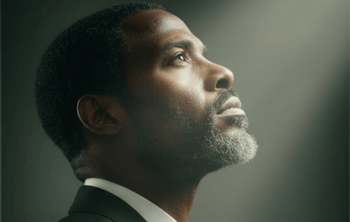


His anger is not the problem. His anger is the signal. What is underneath it is where the real information is.
Before anything else gets said in this post, something needs to be named directly. Black men's anger has been weaponized against them for a long time. The narrative that Black men are inherently aggressive, inherently dangerous, inherently to be feared when they raise their voice or show intensity, that narrative is not a psychological observation. It is a cultural imposition with a long and documented history. It has been used to justify things that do not need to be listed here because every Black man reading this already knows what it has been used to justify.
That reality does not disappear when the conversation turns to emotional health. It sits in the room. It is part of why so many Black men learned early to manage, suppress and apologize for anger that was completely reasonable given everything they were carrying. It is part of why the word angry attached to a Black man still functions as a verdict rather than a description.
That needs to be acknowledged before any of the psychology enters the conversation. Because this is not a blog about teaching Black men to calm down. It is a blog about understanding what the anger has been trying to say all along.
What anger actually is: the psychology of a secondary emotion
Anger is what psychologists call a secondary emotion. That does not mean it is less real or less powerful. It means it is almost never the first thing. It is what arrives on top of something else, something that did not have a safe way to surface, so it came out as fire instead.
Underneath most anger is one of four things. Grief. Fear. Shame. Exhaustion. Sometimes a combination of all four running simultaneously with no language for any of them and no space where they could have been expressed before they reached the threshold where anger was the only thing left.
The psychology of this is well established and it applies across the human population. But the way it plays out in Black men has a specific shape that generic emotional health content consistently misses. Because the sources of grief, fear, shame and exhaustion for a Black man in this society are not the same as the sources for the default population most of that content was written for. And the cultural permissions around expressing any of those things, the access to vulnerability, the safety of saying I am afraid or I am grieving or I am ashamed, are dramatically different.
Black men were handed one emotional language in most of the environments that shaped them. That language was anger. Not because Black men are less emotionally complex than anyone else. Because anger was the only emotion that did not read as weakness. Everything else got compressed and stored. Then it came out sideways.
That is not a character flaw. That is a predictable outcome of a specific set of conditions. Understanding it changes everything about how the anger gets read, addressed and worked with.
The Black Men Who Hold It Together: The Complete Guide to Emotional Wellness, Caregiving, and Relationships on Black men, anger and the emotional signal framework maps this in full structural detail. It is the foundation this post is built on.
What Black men's anger is usually covering
Here is where specificity matters. Generic content says anger covers other emotions. This post is going to name what those emotions are in the actual lived context of Black men's lives.
Grief that never got a funeral. The losses Black men carry are real and they are often unmourned in any formal sense. The father who was not there. The version of himself that got suppressed early to survive. The dreams that did not survive contact with what the world was actually offering. The friends lost to violence, incarceration or the slow drift of lives that went in different directions under impossible pressure. Black men are carrying grief that was never given permission to exist as grief. It existed as silence instead. And silence under enough pressure becomes heat.
Fear that had to be hidden to stay alive. From early childhood, many Black men learned that expressing fear was a liability. Fear in public, for a Black man in certain environments, has historically been dangerous. Fear in front of white authority reads as guilt. Fear in front of peers reads as weakness. So it went underground. It stayed underground. It learned to present as aggression because aggression is the posture that has historically produced less catastrophic outcomes in rooms where fear was not safe. That learned conversion from fear to anger does not disappear when the man grows up. It becomes reflex.
Shame that was installed without consent. Shame about circumstances he did not choose. About the body he inhabits and what that body signals to the world around him. About needs he was taught he should not have. About the distance between who he was told he should be and what the conditions around him actually allowed. Shame is one of the most potent drivers of anger because it is unbearable to sit with and anger is the fastest available route out of it.
Exhaustion past the point of language. Black Men and Emotional Exhaustion: When Holding It Together Becomes the Problem and Invisible Labor: What Black Men Do That Nobody Counts both cover what Black men are carrying before any single triggering event even enters the picture. When a man is already running at the edge of his capacity and something tips the balance, what comes out is not proportional to the triggering event. It is proportional to everything that was already there. The anger looks like an overreaction from the outside. From the inside it is the accumulated weight of things that had nowhere else to go.
If this sounds like you, enter your email and get the guide 5 Signs You're Surviving When You Should Be Healing. It takes 90 seconds and gives you clarity on what you have been carrying.
Why the usual response to it makes things worse
The standard response to Black men's anger, across most of the environments they move through, is management. Contain it. Reduce it. Demonstrate that you are not a threat. Apologize for the volume even when the content was completely legitimate.
What that response does not do is ask what the anger was about. And because nobody asks, the thing underneath it, the grief, the fear, the shame, the exhaustion, never gets addressed. It gets compressed again. It waits for the next time the pressure builds past the threshold. And the cycle continues.
In relationships this plays out with particular damage. His partner reacts to the anger as the event. He reacts to her reaction as evidence that he is not safe to be vulnerable with. The actual thing, the grief or fear or exhaustion that triggered the anger, never surfaces. The argument is about the anger itself. The relationship accumulates damage around something that was never the real conversation to begin with.
Why Black Men Go Quiet: Understanding Emotional Shutdown covers where this cycle ends when it runs long enough. The shutdown that follows chronic misread anger is not indifference. It is a man who learned that expressing anything, including the secondary emotion of anger, produces outcomes that cost more than the silence.
The relationship cost of this dynamic is significant and it is recoverable, but not through anger management techniques that treat the symptom while the source goes unnamed. Recovery requires understanding what the anger was covering and building the capacity to access those underlying emotions before they reach the threshold where anger is the only exit.
What it looks like to process the thing underneath
Processing the source emotion rather than managing the surface anger is not a soft skill. It is a rigorous, demanding practice that requires a man to develop a level of internal awareness that most men, across all backgrounds, were never given tools for.
For Black men it requires additional work because the cultural permissions for grief, fear and shame are even more restricted. It requires finding safe environments, which may be rare and may need to be deliberately constructed. It requires developing a vocabulary for internal states that were never named in the environments where he was formed. It requires a willingness to sit with discomfort that has always converted to anger before it could be examined.
What it produces on the other side is significant. A man who can locate the grief underneath the anger does not stop being powerful. He stops being destabilized by it. A man who can name the fear before it converts is not less strong in the room. He is more precise. A man who can sit with his own shame long enough to examine where it came from is not diminished by that examination. He is freed from the automatic responses that shame has been running in him without his full authorization.
The man who understands what his anger is covering does not become less powerful. He becomes harder to destabilize.
That work does not happen by accident. It happens through deliberate practice, the right frameworks and the decision to stop outsourcing his emotional life to whatever the default response has always been.
Healing in His Prime was built for exactly this work. It addresses the specific sources of what Black men are carrying underneath the surface presentation, the grief, the fear, the shame, the exhaustion and it gives a working framework for beginning to process what has been stored rather than simply managing how it comes out. Not therapy-speak. Not generic wellness content written for a different default. A direct, practical resource built for this specific man and this specific terrain.
Black Men Holding It Together sits alongside it for the man who is ready to look at the full architecture of what he has been carrying across every domain of his life and build something more sustainable than the endurance model he inherited.
What changes in relationships when anger is read correctly
When a man develops the capacity to read his own anger as a signal and trace it back to the source, something shifts in every relationship around him.
His partner stops receiving the anger as the event and starts being invited into the actual conversation. The thing that was underneath. The fear that the relationship is losing something. The grief about what he thought this season of life would look like. The exhaustion from a week of carrying everything without a word for how heavy it was. Those conversations are possible. They produce connection instead of damage. They close the distance that the anger, misread and mis-responded to, was building between them.
His children stop experiencing him as unpredictable and start experiencing him as present. A man who can locate and name what is happening inside him is a man who can stay in the room when it gets hard. Who can regulate without disappearing. Who can model for his sons and daughters an emotional range that they were probably not going to see modeled anywhere else.
He stops losing ground at work to reactions that were never really about what was happening in the room. The precision that comes from knowing what he is actually responding to is a professional asset. It keeps him in his power in situations designed to destabilize him.
This is the standard that The Living Principles Collection was built to represent, not performance, not image management, but the actual internal work that a man committed to self-leadership and principled partnership carries into every room he enters. The pieces in that collection are not accessories. They are a daily declaration that the work is ongoing, that discipline and emotional maturity are not destinations but practices and that leadership begins with how a man carries himself when nobody is watching. If that standard resonates with where you are headed, The Living Principles Collection is available on Black Men In Partnership and it was made for men in motion.
There is a version of you that is not running on compressed grief and converted fear. That version is not soft. That version is not less. That version is more available, more precise, more present and significantly harder to knock off his foundation.
He is not far away. He is on the other side of understanding what the anger has been trying to tell you.
Healing in His Prime is where that work begins. It is available now on the Black Men in Partnership website. So is Black Men Holding It Together for the man ready to go further. And The Living Principles Collection anger as secondary emotion for the man who wants what he is building on the inside to be visible on the outside.
The signal has been there the whole time. Now you know what it means.
Disclaimer: This content is for informational and educational purposes only. The author is not a licensed therapist, counselor, or medical professional. It is not a substitute for professional mental health or therapeutic care. If you are in a mental health crisis, please seek support from a qualified professional.
In partnership and progress, Celeste M. Blake, Author and Wellness Advocate, Founder of Black Men in Partnership. Because strong, present, and whole is not a performance. It is a choice made daily. blackmeninpartnership.com, Because strong, present, and whole is not a performance. It is a choice made daily. For the man who keeps choosing to grow.